
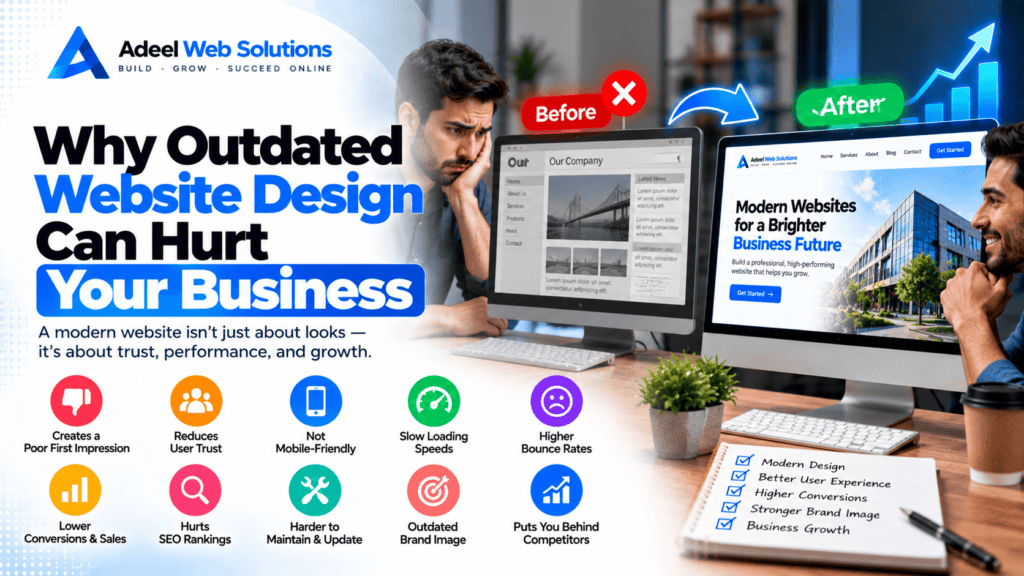
Why Outdated Website Design Can Hurt Your Business
Your website is often one of the first places potential customers interact with your business. Before calling, visiting your office, requesting a quote, or making a purchase, many people will look at your website to understand who you are and whether your business appears credible.
If your website looks outdated, loads slowly, is difficult to navigate, or does not work properly on mobile devices, visitors may form a negative impression before they ever speak with you.
An outdated website is not simply a design problem. It can affect customer trust, user experience, lead generation, conversions, mobile usability, website performance, and your overall digital presence.
In this article, we’ll explain why outdated website design can hurt your business, which warning signs to look for, and when it may be time to consider a professional website redesign.
What Makes a Website Look Outdated?
Website design trends change, but an outdated website is not simply one that was created several years ago.
A well-designed older website can still perform effectively if it is properly maintained.
Problems begin when the website no longer meets modern customer or technical expectations.
Common signs include:
- Non-responsive layouts
- Tiny text
- Old-fashioned navigation
- Cluttered pages
- Low-quality images
- Outdated branding
- Broken links
- Slow loading
- Flashy or excessive animations
- Old contact information
- Difficult forms
- Poor mobile usability
- Outdated content
- Security warnings
- Broken functionality
If several of these issues are present, the website may no longer represent your business effectively.
1. An Outdated Website Can Create a Poor First Impression
Customers often form an impression of a business very quickly.
When someone visits your website and sees an old layout, low-resolution images, broken elements, or outdated information, they may wonder whether the business is still active or professionally maintained.
This can happen even when the company itself provides excellent products or services.
Your website should reflect the current quality of your business.
A modern website can communicate:
- Professionalism
- Attention to detail
- Credibility
- Organization
- Brand consistency
An outdated website can make it harder to communicate these qualities.
2. It Can Reduce Customer Trust
Trust is especially important when visitors are being asked to:
- Submit personal information
- Request a quote
- Schedule an appointment
- Make a payment
- Purchase a product
- Create an account
If the website looks neglected, visitors may hesitate.
Potential warning signs include:
- Broken pages
- Missing images
- Old copyright dates
- Incorrect business information
- Outdated staff profiles
- Security warnings
- Broken forms
- Inconsistent branding
Keeping your website current shows visitors that the business actively maintains its online presence.
3. Poor Mobile Design Can Drive Visitors Away
Modern websites need to work across different screen sizes.
An outdated website may have been designed primarily for desktop computers.
On smartphones, visitors may experience:
- Tiny text
- Horizontal scrolling
- Buttons that are difficult to tap
- Images extending beyond the screen
- Broken menus
- Forms that are difficult to complete
Mobile users should not need to zoom in and out simply to navigate your website.
Responsive design allows the layout to adapt to desktop computers, tablets, and smartphones.
4. Outdated Navigation Makes Information Difficult to Find
Website navigation should help visitors quickly find the information they need.
Older websites sometimes contain:
- Too many menu items
- Complicated dropdowns
- Unclear page names
- Duplicate pages
- Important pages buried several levels deep
Visitors should be able to quickly locate:
- Services
- Products
- About information
- Pricing
- Contact details
- Locations
- FAQs
If navigation feels confusing, visitors may leave before reaching an important conversion page.
5. Outdated Design Can Hurt Conversions
A website should help visitors take meaningful actions.
Depending on your business, that might include:
- Calling
- Requesting a quote
- Booking an appointment
- Submitting a form
- Purchasing a product
- Scheduling a consultation
Older websites often have weak or unclear calls-to-action.
Visitors may not know what to do next.
A modern website should use clear CTAs such as:
- Request a Quote
- Contact Us
- Book an Appointment
- Schedule a Consultation
- Get Started
- Shop Now
These actions should be easy to find without overwhelming the visitor.
6. Slow Website Performance Can Frustrate Customers
Older websites can accumulate technical problems over time.
For WordPress websites, this may include:
- Outdated plugins
- Heavy themes
- Oversized images
- Unused scripts
- Poor caching
- Database clutter
- Excessive third-party tools
A redesign provides an opportunity to review these problems and rebuild pages more efficiently.
However, a new visual design alone does not guarantee better speed. Performance should be considered throughout development.
7. Outdated Websites May Perform Poorly on Modern Browsers
Web technologies evolve.
A website created many years ago may rely on code or functionality that no longer behaves correctly across current browsers and devices.
Problems might include:
- Broken layouts
- Unsupported functionality
- JavaScript errors
- Incorrect form behavior
- Media playback problems
Regular maintenance and modern development practices help keep a website compatible with current technology.
8. Old Content Can Damage Credibility
Website design is not only visual.
Outdated content can be just as damaging.
Examples include:
- Services you no longer provide
- Incorrect pricing
- Former employees
- Old business hours
- Old phone numbers
- Incorrect locations
- Expired promotions
- Outdated policies
Imagine a potential customer calling a phone number listed on your website only to discover that it no longer works.
That creates unnecessary friction and can reduce confidence in the business.
A redesign is an excellent opportunity to perform a complete content audit.
9. Your Branding May No Longer Match Your Business
Businesses evolve.
Over time, you may change:
- Your logo
- Brand colors
- Services
- Target audience
- Messaging
- Positioning
If your website still represents the company as it existed years ago, there can be a disconnect between your online presence and your current brand.
A redesign can align the website with your current identity.
Brand consistency should extend across:
- Website
- Social media
- Advertising
- Printed materials
This creates a more recognizable customer experience.
10. Poor Website Structure Can Affect SEO
An outdated website may have structural problems that make SEO more difficult.
Examples include:
- Poor heading structure
- Duplicate pages
- Broken links
- Missing metadata
- Weak internal linking
- Unclear URLs
- Thin service pages
- Poor mobile usability
A redesign can provide an opportunity to improve these areas.
However, SEO must be protected during the redesign.
Existing URLs that already receive traffic or backlinks should not be changed unnecessarily.
If URLs must change, appropriate redirects should be implemented.
11. Outdated Websites May Have Security Risks
Older websites may depend on outdated:
- WordPress versions
- Themes
- Plugins
- PHP versions
- Custom code
Unsupported software can create security risks.
A redesign can provide an opportunity to remove abandoned components and modernize the technology stack.
However, security requires ongoing maintenance even after the redesign is complete.
Regular updates, backups, monitoring, and secure hosting practices remain important.
12. Old Forms Can Reduce Lead Generation
Contact forms are often one of the most important conversion tools on a business website.
Older forms may contain:
- Too many fields
- Poor mobile layouts
- Broken validation
- Confusing labels
- Outdated recipients
- No confirmation message
- Submission errors
Forms should be simple and easy to complete.
For many businesses, a basic enquiry form may only need:
- Name
- Phone
- Service
- Message
Always test form submissions and confirm that enquiries reach the correct destination.
13. Your Competitors May Provide a Better Online Experience
Customers often compare several businesses before making a decision.
They may open multiple websites and compare:
- Services
- Pricing
- Reviews
- Experience
- Locations
- Availability
- Professionalism
If competitors provide fast, modern, mobile-friendly websites while yours feels difficult to use, the difference can influence customer perception.
This does not mean copying competitors.
Your website should clearly communicate your own strengths while meeting reasonable modern usability expectations.
14. Poor Accessibility Can Exclude Visitors
Older websites may not have been designed with accessibility in mind.
Potential problems include:
- Low text contrast
- Tiny fonts
- Missing image alternative text
- Poor heading structure
- Unlabeled form fields
- Difficult keyboard navigation
- Unclear links
Improving accessibility can make your website easier to use for a wider range of visitors.
Accessibility should be considered during the redesign process rather than treated as an afterthought.
15. Outdated Websites Are Often Harder to Maintain
An older website may become difficult for your team to update.
Simple changes might require:
- Developer assistance
- Editing code
- Working with outdated builders
- Navigating complicated templates
A modern CMS setup can make routine updates easier.
For example, businesses may want to update:
- Services
- Team members
- Blog posts
- Testimonials
- Images
- FAQs
- Contact information
A redesign can simplify the website’s backend as well as its frontend.
Signs Your Website May Need a Redesign
Consider reviewing your website if:
- It looks noticeably outdated.
- It isn’t mobile responsive.
- Pages load slowly.
- Navigation is confusing.
- Content is outdated.
- Forms don’t work reliably.
- Your branding has changed.
- Customers struggle to find information.
- The website is difficult to maintain.
- It uses outdated technology.
- Important pages aren’t generating enquiries.
- Your business has significantly changed since the website was created.
One problem alone may not justify a complete rebuild.
Sometimes targeted improvements are enough.
However, several overlapping issues may indicate that a broader redesign would be more practical.
What Should a Modern Business Website Include?
Every business is different, but modern websites commonly benefit from:
- Responsive design
- Clear navigation
- Fast loading
- Strong branding
- Readable typography
- High-quality images
- Clear calls-to-action
- Easy-to-use forms
- Accurate contact information
- Useful service content
- Security best practices
- SEO-friendly structure
The exact features should be based on your business and customer requirements.
Avoid adding functionality simply because it is fashionable.
Redesign vs Refresh: Which Do You Need?
Not every outdated website needs a complete rebuild.
Website Refresh
A refresh may involve:
- Updating colors
- Improving typography
- Replacing images
- Updating content
- Improving CTAs
- Making smaller layout changes
This may be enough when the website’s underlying structure and technology are still effective.
Website Redesign
A complete redesign may be more appropriate when there are deeper problems involving:
- Navigation
- Mobile responsiveness
- Performance
- Content structure
- Technology
- Branding
- Conversion paths
Evaluate the actual problems before deciding which approach makes sense.
Protect Your SEO During a Redesign
If you decide to redesign, don’t remove the old website without an SEO migration plan.
Before launch:
- Record existing URLs.
- Identify important pages.
- Review organic traffic.
- Preserve valuable content.
- Maintain important URLs where possible.
- Create redirects for changed URLs.
- Check titles and metadata.
- Review internal links.
- Generate an updated sitemap.
- Check indexing settings.
After launch, monitor for:
- 404 errors
- Redirect problems
- Indexing issues
- Traffic changes
SEO migration should be part of the redesign project from the beginning.
Website Redesign Checklist
Before rebuilding an outdated website, review:
- Business goals
- Target audience
- Branding
- Website analytics
- Existing SEO
- Content
- URLs
- Navigation
- Mobile responsiveness
- Website speed
- Core Web Vitals
- Forms
- Calls-to-action
- Hosting
- Security
- Accessibility
- Integrations
- Analytics tracking
- Redirects
- Pre-launch testing
Planning these areas early can prevent expensive problems later.
Don’t Redesign Only Because of Trends
Website trends change constantly.
A business website does not need to follow every new visual trend.
The most important qualities are:
Clarity + Usability + Speed + Trust + Accessibility + Conversion
A simple website that clearly communicates what a company does can outperform a visually complicated website that confuses visitors.
Design decisions should support your business goals rather than simply follow trends.
Final Thoughts
An outdated website can affect much more than your company’s appearance.
It can influence how customers perceive your business, how easily they navigate your services, whether they trust your company, and whether they ultimately contact you or make a purchase.
Common warning signs include poor mobile responsiveness, slow performance, outdated content, difficult navigation, broken forms, inconsistent branding, and old technology.
If your website has only a few small problems, targeted improvements may be enough.
But when several areas are outdated at the same time, a professional redesign can provide an opportunity to improve the entire customer experience.
The goal should not simply be to make your website look newer.
The goal should be to create a website that is modern, fast, trustworthy, easy to use, mobile-friendly, and aligned with your current business goals.
Is Your Business Website Outdated?
If your website no longer represents your business, performs poorly on mobile devices, loads slowly, or makes it difficult for customers to take action, it may be time to consider a redesign.
At Adeel Web Solutions, we help businesses redesign outdated websites with a focus on modern design, responsive layouts, WordPress development, website performance, SEO-conscious structure, and improved user experience.
Whether you need a visual refresh, WordPress redesign, Elementor rebuild, mobile optimization, speed improvements, or a complete website transformation, we can help create a website that better represents your business today.
Contact Adeel Web Solutions today to discuss your website redesign and build a stronger online presence for your business.
