

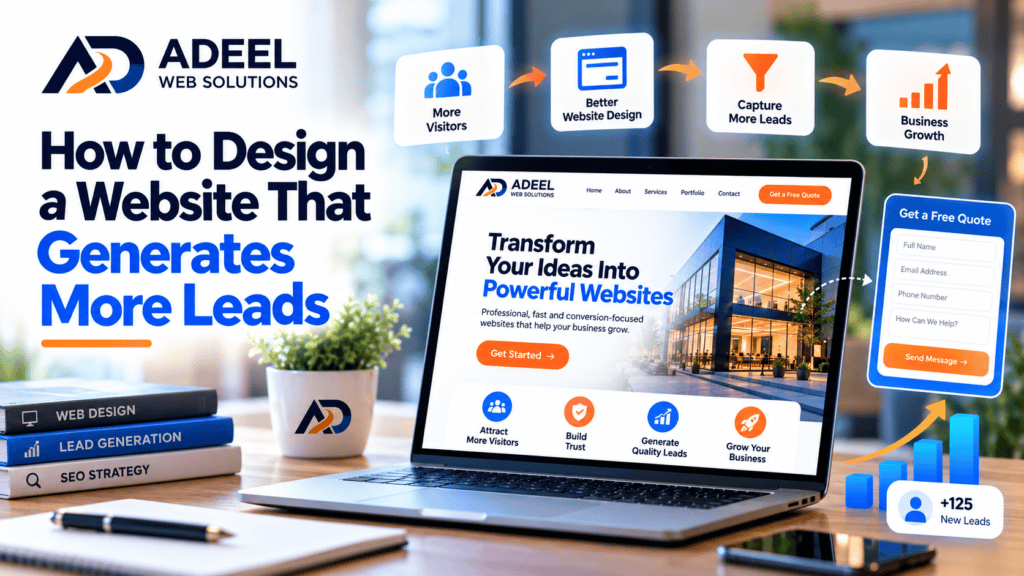
How to Design a Website That Generates More Leads
A website should do more than simply make your business look professional. It should help turn visitors into potential customers.
Many businesses invest in a website but struggle to generate inquiries, phone calls, quote requests, bookings, or sales. The problem is not always a lack of traffic. Sometimes, visitors are reaching the website but the design does not give them enough information, confidence, or direction to take the next step.
A lead-generating website combines professional design, clear messaging, strong calls to action, useful content, trust signals, fast performance, and an easy user experience.
If you want your business website to generate more leads, here are the most important elements to consider.
1. Understand Your Target Customer
Before designing your website, you need to understand who you want to attract.
Different customers have different needs, concerns, and reasons for choosing a business.
Ask yourself:
- Who is my ideal customer?
- What problem are they trying to solve?
- Which services are they looking for?
- What questions might they have?
- What concerns could prevent them from contacting us?
- What information would help them make a decision?
Your website should be designed around your customers rather than around your personal design preferences.
For example, someone searching for an emergency plumbing service probably wants a phone number, availability information, service areas, and reassurance that help is available quickly.
Someone searching for a website development company may want to see services, previous projects, testimonials, technical capabilities, and an easy way to request a quote.
Understanding customer intent helps you create a more effective website.
2. Create a Clear Value Proposition
When someone lands on your homepage, they should quickly understand what your business provides.
Avoid generic headings such as:
“Welcome to Our Website.”
Instead, create a headline that clearly communicates your primary service or benefit.
For example:
Professional Website Design for Growing Businesses
or:
Modern Websites Designed to Turn Visitors Into Customers
Underneath the main headline, add a short description explaining who you help and what you provide.
Clear messaging reduces confusion and encourages visitors to continue exploring your website.
3. Put a Strong Call to Action Above the Fold
The area visitors see before scrolling is commonly called the “above-the-fold” section.
This is valuable space.
Your primary call to action should usually be visible here.
Depending on your business, this could be:
Request a Free Quote
Schedule a Consultation
Book an Appointment
Call Now
Get Started
Contact Our Team
The call-to-action button should visually stand out from the surrounding design.
Visitors who are already ready to contact you should not have to search through several sections to find the next step.
4. Keep Navigation Simple
Complicated navigation can reduce conversions by making visitors work harder to find information.
For many businesses, a simple navigation structure works well:
- Home
- About
- Services
- Projects or Portfolio
- Service Areas
- Blog
- Contact
If you provide several services, organize them logically underneath your Services menu.
Important pages should be accessible within a few clicks.
Your navigation should help potential customers move naturally from learning about your business to understanding your services and finally contacting you.
5. Create Dedicated Pages for Your Services
If lead generation is important, avoid describing every service in a few lines on one general page.
Create dedicated pages for your major services.
For example, a digital agency could create individual pages for:
- Website Design & Development
- WordPress Development
- E-commerce Development
- Landing Page Design
- Website Redesign
- Website Maintenance
- Search Engine Optimization
Dedicated pages allow you to explain each service in greater detail and answer questions specific to that service.
They can also create more opportunities for search engines to understand your website and connect individual pages with relevant searches.
Each service page should have a clear call to action encouraging interested visitors to contact you.
6. Focus on Benefits, Not Just Features
Businesses often focus too heavily on what they provide rather than why it matters to customers.
For example:
Feature: Responsive website design.
Benefit: Customers can easily use your website on smartphones, tablets, and desktop computers.
Another example:
Feature: Website speed optimization.
Benefit: Visitors can access your pages faster and experience less frustration while browsing.
Features are important, but customers also need to understand how those features help solve their problems.
A good website communicates both.
7. Use Trust Signals
Before contacting a business, visitors want reassurance that the company is legitimate and capable of delivering what it promises.
Trust signals can reduce uncertainty.
Depending on your industry, these may include:
- Customer testimonials
- Online reviews
- Case studies
- Completed projects
- Professional certifications
- Industry memberships
- Years of experience
- Client logos
- Awards
- Guarantees
- Team profiles
Only use genuine and verifiable trust signals.
Real customer feedback and authentic examples of your work are much more valuable than exaggerated marketing claims.
8. Show Real Examples of Your Work
A portfolio or project gallery can be a powerful lead-generation tool.
Potential customers often want to see evidence of your capabilities before contacting you.
If you are a web designer, show websites you have developed.
If you are a contractor, show completed construction or renovation projects.
If you are a roofing company, show before-and-after photos.
If you provide marketing services, consider presenting case studies.
A case study can explain:
The Problem: What challenge did the customer have?
The Solution: What did your company provide?
The Result: What happened after the project?
This helps potential customers imagine what your business could accomplish for them.
9. Make Contact Forms Easy to Complete
A contact form should make becoming a lead simple.
Do not ask for unnecessary information.
For many service businesses, a form containing the following fields may be sufficient:
- Full Name
- Email Address
- Phone Number
- Service Required
- Message
If you need additional information to provide a quote, you can add relevant fields.
However, consider whether every field is genuinely necessary.
Long, complicated forms can create unnecessary friction for visitors who simply want to ask a question.
10. Add Calls to Action Throughout Important Pages
You do not have to rely on a single button at the top of the website.
Calls to action can appear naturally throughout important pages.
For example, a service page might have a CTA after explaining the service, another after showing testimonials, and a final one near the bottom.
Useful CTA text includes:
Request a Quote
Talk to Our Team
Schedule Your Consultation
Get a Free Estimate
Start Your Project
Avoid overwhelming visitors with too many different actions.
Choose one primary conversion goal and make it consistent.
11. Optimize Your Website for Mobile Leads
A significant portion of potential customers may visit your website from smartphones.
Your mobile website should make contacting your business extremely easy.
Consider features such as:
- Click-to-call phone numbers
- Large CTA buttons
- Short contact forms
- Simple menus
- Readable text
- Fast-loading pages
- Mobile-friendly booking systems
For local service businesses, a sticky Call Now or Request a Quote button can make important actions accessible while visitors browse.
Always test your website on real mobile devices rather than relying only on desktop previews.
12. Improve Website Speed
Every additional delay creates an opportunity for a potential customer to leave.
Large images, unnecessary plugins, excessive scripts, animations, and poor hosting can slow down a website.
Performance improvements may include:
- Compressing images
- Using modern image formats
- Implementing browser caching
- Removing unnecessary plugins
- Reducing unused scripts
- Optimizing website code
- Using reliable hosting
Performance should be considered throughout the website development process rather than only after launch.
13. Create Landing Pages for Marketing Campaigns
If you run Google Ads, social media advertising, email campaigns, or other promotions, sending every visitor to your homepage may not always be the best strategy.
A dedicated landing page can focus on one specific service or offer.
For example:
Google Ad: Emergency Plumbing Services
Landing Page: Emergency Plumber in Your Service Area
The landing page can focus entirely on the visitor’s immediate need.
An effective landing page might include a strong headline, benefits, trust signals, reviews, relevant service information, FAQs, and a clear contact form.
Removing unnecessary distractions can help visitors focus on the primary action.
14. Use Customer Testimonials Strategically
Testimonials should not necessarily be limited to one Reviews page.
Place relevant testimonials near important conversion points.
For example, if a customer provides positive feedback about your WordPress development service, you could display that testimonial directly on your WordPress service page.
This provides reassurance at the moment a visitor is considering that particular service.
Testimonials work best when they are authentic and specific.
15. Answer Common Questions With FAQs
Potential customers often hesitate because they still have unanswered questions.
A Frequently Asked Questions section can help remove these obstacles.
Questions might include:
- How much does your service cost?
- How long does the process take?
- Which areas do you serve?
- Do you provide ongoing support?
- How do I get started?
- What information do you need from me?
- Can you work with my existing website?
Good FAQs can save customers time and help them feel more comfortable before contacting you.
16. Provide Multiple Ways to Contact Your Business
Not every visitor wants to communicate in the same way.
Some customers prefer phone calls, while others prefer email or contact forms.
Depending on your business, you may provide:
- Phone number
- Email address
- Contact form
- Appointment booking
- Live chat
- Physical location
Make your primary contact information easy to find in your header, footer, and Contact page.
Do not make customers search for a way to reach you.
17. Create Useful SEO Content
Generating leads requires visitors, and search engine optimization can help potential customers discover your website.
Create useful content around the services and questions your customers are actually searching for.
Your website might include service pages, location pages, FAQs, guides, case studies, and educational blog articles.
For example, a web development company might publish articles such as:
How Much Does a Small Business Website Cost?
WordPress vs Shopify: Which Is Better for Your Business?
How to Improve Your Website Speed
10 Signs Your Business Website Needs a Redesign
Useful content can attract potential customers earlier in their research process and introduce them to your business.
18. Reduce Distractions
More website elements do not necessarily mean more leads.
Too many pop-ups, animations, sliders, buttons, banners, and competing offers can make it difficult for visitors to understand what they should do.
Each page should have a clear hierarchy.
The visitor should naturally move from:
Problem → Solution → Benefits → Evidence → Call to Action
Keep the design focused on the customer’s journey.
19. Track Your Leads and Conversions
You cannot effectively improve lead generation if you do not know what is working.
Businesses should consider tracking meaningful actions such as:
- Contact form submissions
- Quote requests
- Phone calls
- Appointment bookings
- Email clicks
- Purchases
- Important CTA clicks
Analytics can also help you understand which pages attract visitors and which traffic sources generate valuable inquiries.
For example, you may discover that one service page receives significant traffic but very few leads.
That could indicate that the page needs stronger messaging, better trust signals, clearer pricing information, or a more visible CTA.
20. Continuously Test and Improve
A lead-generating website is never truly finished.
Customer behavior, technology, search trends, and business goals change over time.
Regularly review your website and test important elements.
You might experiment with different headlines, CTA wording, form lengths, page layouts, images, or landing-page content.
Instead of redesigning your entire website based on assumptions, use actual performance data to identify opportunities for improvement.
What Does a High-Converting Website Need?
A lead-generating website does not need to be complicated.
It needs to communicate clearly, establish trust, and make taking action easy.
An effective website generally provides:
Clear messaging that explains what your business offers.
Professional design that creates a credible first impression.
Useful content that answers customer questions.
Social proof that demonstrates previous customer experiences.
Fast performance that provides a smooth browsing experience.
Mobile responsiveness that works across different devices.
Strong calls to action that tell visitors what to do next.
Simple forms that make contacting your business easy.
When these elements work together, your website can become an important part of your lead-generation strategy.
Turn Your Website Into a Lead-Generation Tool
Your website should not simply exist online. It should actively support your business goals.
Professional website design can help you attract the right visitors, communicate your value, establish credibility, and guide potential customers toward contacting your business.
At Adeel Web Solutions, we design and develop professional, responsive, and conversion-focused websites for businesses that want to strengthen their online presence and generate more opportunities.
Whether you need a new business website, WordPress development, an e-commerce website, a high-converting landing page, website redesign, or ongoing maintenance, we can help you create a website built around your goals.
Ready to turn more website visitors into potential customers? Contact Adeel Web Solutions today to discuss your project and start building a website designed to generate leads.
