

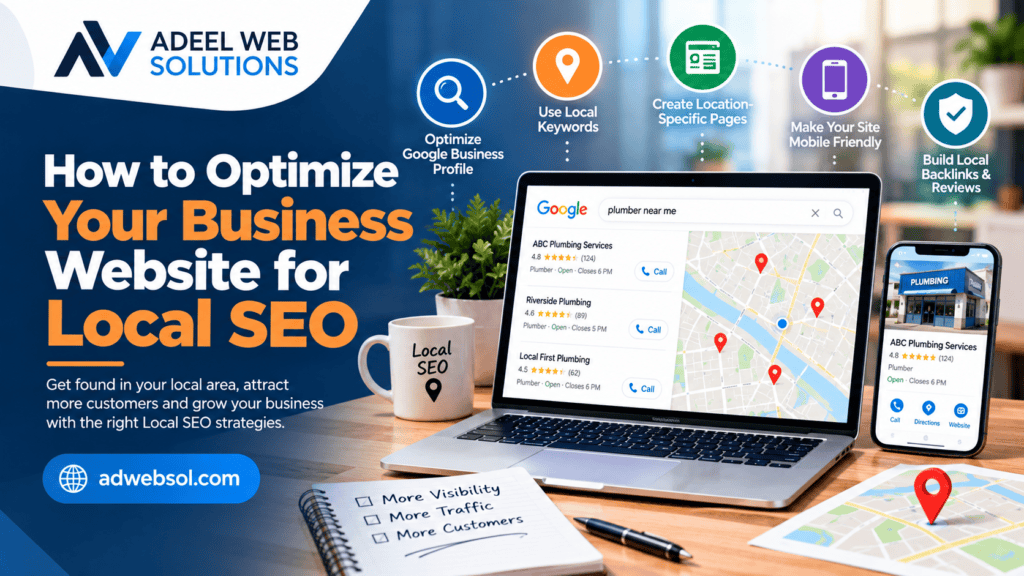
How to Optimize Your Business Website for Local SEO
If your business serves customers in a specific city, region, or service area, appearing in relevant local search results can be an important source of website traffic, phone calls, enquiries, bookings, and store visits.
When someone searches for terms such as “plumber near me,” “web designer in Charlotte,” “dentist in Canberra,” or “roofing company in Wichita,” search engines try to provide results that are relevant to both the service and the searcher’s location.
This is where local SEO becomes important.
Local SEO is the process of improving your website and broader online presence so your business can be discovered more effectively by people searching for products or services in the areas you serve.
It involves more than adding a city name to a few pages. Effective local SEO can include your website structure, Google Business Profile, service pages, location pages, business information, reviews, local citations, internal linking, structured data, backlinks, mobile usability, and technical SEO.
In this guide, we explain how to optimize your business website for local SEO and build a stronger foundation for attracting relevant local customers.
What Is Local SEO?
Local SEO is a branch of search engine optimization focused on improving visibility for searches with local intent.
Local intent means the searcher is looking for a business, service, product, or information connected to a particular geographic area.
Examples include:
- Web developer in Dallas
- Plumber near me
- Roofing contractor in Charlotte
- Electrician in Jacksonville
- Dentist in Canberra
- Pool repair company in Rhode Island
- Restaurants near downtown
- Emergency plumber near me
Google and other search engines may use several signals to determine which businesses and pages are relevant to these searches.
Your goal is to make it clear:
- What your business does
- Where your business is located
- Which areas you serve
- Which services you provide
- How customers can contact you
Local SEO vs Traditional SEO
Traditional SEO and local SEO share many principles, but local SEO adds a geographic element.
Traditional SEO may target a keyword such as:
Website Maintenance Services
Local SEO may target:
Website Maintenance Services in Charlotte
Traditional SEO may focus heavily on:
- Content quality
- Keywords
- Backlinks
- Technical SEO
- User experience
Local SEO can also involve:
- Google Business Profile
- Local citations
- Reviews
- Location pages
- Local backlinks
- Consistent business information
For local businesses, both approaches can work together.
1. Optimize Your Google Business Profile
For businesses eligible for a Google Business Profile, it can be one of the most important components of local search visibility.
Your profile can display information such as:
- Business name
- Address or service area
- Phone number
- Website
- Business category
- Opening hours
- Photos
- Reviews
- Services
Make sure the information accurately reflects your real business.
Choose the Most Appropriate Business Category
Your primary category should closely describe your main business activity.
Additional categories can be added when they accurately represent other services you provide.
Avoid selecting unrelated categories simply to appear for additional searches.
Complete Your Business Information
Provide accurate information wherever applicable.
This may include:
- Business hours
- Contact information
- Website
- Services
- Business description
- Photos
A complete and accurate profile gives customers more useful information about your business.
2. Keep Your Business Information Consistent
Your business name, address, and phone number are often referred to as NAP information:
Name – Address – Phone
These details should be accurate and reasonably consistent across your online presence.
Check places such as:
- Your website
- Google Business Profile
- Business directories
- Social profiles
- Industry directories
- Local directories
If your business changes its phone number, address, or other important details, update major listings rather than allowing outdated information to remain online.
Consistency makes it easier for both customers and search engines to understand your business information.
3. Optimize Your Homepage for Your Primary Location
If your business primarily serves one geographic market, your homepage can make that location clear.
For example, instead of using only:
Professional Plumbing Services
you might use:
Professional Plumbing Services in Jacksonville, FL
when that accurately describes your business.
Location information can naturally appear in:
- Main heading
- Introductory content
- Service descriptions
- Page title
- Meta description
- Contact information
- Footer
Avoid repeating the city name unnaturally throughout every paragraph.
Write primarily for potential customers.
4. Create Dedicated Service Pages
One of the most useful SEO improvements for service businesses is creating a strong page for each important service.
Instead of placing every service on one short page, you may create pages such as:
- Website Design
- WordPress Development
- E-commerce Development
- Website Maintenance
- SEO Services
For a roofing company, pages might include:
- Roof Repair
- Roof Replacement
- Commercial Roofing
- Storm Damage Repair
- Roof Inspections
Dedicated service pages provide more space to explain each service clearly.
They can also target relevant search intent more precisely.
5. Create Useful Location Pages
If your business genuinely serves multiple areas, dedicated location or service-area pages can be valuable.
For example:
example.com/service-areas/charlotte-nc/
example.com/service-areas/belmont-nc/
example.com/service-areas/gastonia-nc/
Each page should provide useful information specifically relevant to customers in that location.
Avoid Creating Near-Identical Location Pages
A common local SEO mistake is generating dozens or hundreds of pages where only the city name changes.
For example:
We provide professional plumbing services in Charlotte.
and then:
We provide professional plumbing services in Gastonia.
with every other paragraph remaining identical.
This creates little value for users.
Instead, location pages should contain meaningful, location-relevant content where possible.
6. Add Useful Content to Location Pages
A strong service-area page can explain:
- Services available in that area
- Types of customers served
- Relevant local service information
- How your process works
- Why customers choose your company
- Nearby areas served
- Contact options
You may also include genuine:
- Project examples
- Customer testimonials
- Local photos
- Case studies
- Area-specific service considerations
The goal is to create a page that is genuinely useful to someone searching for your service in that location.
7. Perform Local Keyword Research
Before optimizing pages, understand how potential customers search for your services.
Local keywords often combine:
Service + Location
Examples include:
- Web design company in Charlotte
- WordPress developer in Dallas
- Plumber in Jacksonville
- Roofing contractor in Wichita
- Pool repair in Providence
People may also search using terms such as:
- Near me
- Nearby
- Local
- Best
- Emergency
- Affordable
However, you should not automatically create pages for every keyword variation.
Group related keywords according to search intent and create useful pages around meaningful topics.
8. Optimize Page Titles
Your page title is an important on-page SEO element.
For local service pages, a title may include both the service and location when appropriate.
For example:
Roof Repair in Wichita, KS | Business Name
or:
Website Design Services in Charlotte, NC | Business Name
Keep titles descriptive and natural.
Avoid stuffing them with long lists of locations and keywords.
9. Write Useful Meta Descriptions
Meta descriptions can help users understand what a page offers before clicking.
A local service page might use:
Need professional roof repair in Wichita, KS? Our team provides reliable residential and commercial roofing services. Request an estimate today.
A good meta description should:
- Describe the page accurately
- Mention the service
- Mention the location where appropriate
- Communicate a useful benefit
- Include a natural call to action
Search engines may choose to display different text depending on the search, so the written meta description is not guaranteed to appear exactly as provided.
10. Use Clear Heading Structures
Headings organize your content for users and help communicate page structure.
A local service page might use:
H1: Roof Repair Services in Wichita, KS
Then H2 sections such as:
- Residential Roof Repair
- Commercial Roof Repair
- Common Roofing Problems We Fix
- Our Roof Repair Process
- Areas We Serve
- Contact Our Roofing Team
Headings should describe the content rather than simply exist to hold keywords.
11. Add Local Information Naturally to Your Content
Your location should be clear, but local SEO does not require mentioning the city in every sentence.
Write naturally.
Instead of repeating:
“Charlotte web design”
twenty times, explain:
- Your services
- Your process
- Your experience
- Types of businesses you work with
- Areas you serve
- How customers can get started
Then incorporate relevant geographic information where it genuinely improves the page.
Keyword stuffing can make content difficult to read and does not create a good customer experience.
12. Optimize Your Contact Page
Your contact page can reinforce important business and location information.
Depending on your business, it may include:
- Business name
- Address
- Phone number
- Business hours
- Contact form
- Map
- Service areas
Make sure the information matches your primary business listings.
Your phone number should also be easy to use on mobile devices.
For example, a click-to-call link allows smartphone users to contact your business without manually entering the number.
13. Add a Map Where It Helps Customers
If customers visit your physical location, embedding a useful map on your contact or location page can help them find you.
A map may be useful for:
- Medical practices
- Restaurants
- Retail stores
- Offices
- Clinics
- Showrooms
For service-area businesses that travel to customers, a physical office map may be less important.
The website should accurately represent how the business actually operates.
14. Use Local Business Structured Data Appropriately
Structured data can provide search engines with machine-readable information about a business and its content.
Depending on your website and business type, relevant structured data may describe:
- Organization
- Local business
- Address
- Phone number
- Opening hours
- Website
- Services
Structured data should accurately reflect information that is genuinely associated with the business.
It should not contain misleading addresses, reviews, services, or other information.
Correct structured data can help search engines understand your business, but it does not guarantee special search-result features or higher rankings.
15. Build a Strong Internal Linking Structure
Internal links help visitors and search engines navigate your website.
Your homepage can link to major service pages.
Service pages can link to relevant location pages.
Blog articles can link to related services.
Location pages can link to relevant service pages.
For example:
Homepage → Website Maintenance → Charlotte Website Maintenance
and:
Blog Article → Website Maintenance Service
This creates logical connections between related content.
Avoid creating hundreds of keyword-heavy internal links simply for SEO.
Links should primarily help users find relevant information.
16. Earn Customer Reviews
Customer reviews can be valuable for both reputation and local visibility.
Satisfied customers can be encouraged to leave genuine reviews on relevant platforms.
Businesses should never fabricate reviews or create misleading testimonials.
You can make the review process easier by providing customers with a direct review link after completing a service.
Reviews can also provide potential customers with useful information about:
- Service quality
- Communication
- Reliability
- Customer experience
When appropriate, businesses can respond professionally to reviews, including negative feedback.
17. Build Accurate Local Citations
A local citation is an online mention of your business information.
Citations may appear on:
- Business directories
- Local directories
- Industry websites
- Professional associations
- Chamber of commerce websites
Focus on relevant, legitimate platforms rather than submitting your website to hundreds of low-quality directories.
Quality and accuracy are more important than simply creating the largest possible number of listings.
18. Build Relevant Local Backlinks
Backlinks are links from other websites to yours.
For local businesses, useful backlink opportunities may come from:
- Local organizations
- Business associations
- Suppliers
- Partners
- Community websites
- Local publications
- Industry directories
The goal should be earning legitimate links that make sense for your business.
Avoid buying large numbers of low-quality backlinks or participating in manipulative link schemes.
A smaller number of relevant, trustworthy links can be more valuable than hundreds of meaningless directory links.
19. Publish Locally Relevant Content
Your blog can support local SEO when you publish genuinely useful local content.
Depending on your industry, topics could include:
- Local project case studies
- Service guides
- Regional considerations
- Local events connected to your industry
- Common customer questions in your area
- Local regulations relevant to your service
For example, a roofing company could publish content about weather-related roofing problems common in its service region.
A real estate company could publish neighborhood and market guides.
Content should be useful first and locally optimized second.
20. Optimize Images for Local Pages
Images can improve the credibility and usefulness of local pages.
Whenever possible, use genuine business photos such as:
- Completed projects
- Team members
- Office
- Storefront
- Service vehicles
- Local work
Optimize images by:
- Compressing large files
- Using appropriate dimensions
- Choosing descriptive filenames where useful
- Adding accurate alt text
Avoid stuffing city names into every image filename and alt attribute.
Alt text should primarily describe the image accurately and support accessibility.
21. Make Your Website Mobile-Friendly
Local searches frequently happen when people are using mobile devices.
A potential customer may be looking for a business while travelling, comparing nearby services, or trying to call immediately.
Your mobile website should make it easy to:
- Read content
- Navigate
- Call your business
- Submit a form
- Find your location
- Request an estimate
- Book an appointment
Important buttons should be easy to tap, and forms should fit comfortably on smaller screens.
Mobile usability is therefore an important part of both local SEO and conversion optimization.
22. Improve Website Speed
A slow website can frustrate potential customers.
Local businesses should pay attention to performance, particularly on mobile connections.
Website speed improvements may involve:
- Image optimization
- Caching
- Better hosting
- Database optimization
- Reducing unnecessary plugins
- Optimizing scripts
- Removing unnecessary third-party resources
Do not focus only on achieving a perfect performance score.
The priority should be delivering a fast, stable, usable experience for real visitors.
23. Keep Your Website Secure
A compromised website can damage both customer trust and your online presence.
Important security practices include:
- Keeping software updated
- Maintaining backups
- Using HTTPS
- Using strong passwords
- Reviewing administrator access
- Removing unnecessary plugins
- Monitoring suspicious activity
Website security and maintenance should be part of your broader SEO strategy because search visibility has limited value if customers arrive at a website that is broken or unsafe.
24. Use Google Search Console
Google Search Console can help website owners understand how Google interacts with their website.
It can provide information related to:
- Search performance
- Indexing
- Pages
- Sitemaps
- Search queries
- Clicks
- Impressions
- Technical issues
Businesses can use this information to identify which pages receive search visibility and whether important pages are experiencing indexing problems.
Search Console should be monitored periodically rather than configured once and forgotten.
25. Track Local SEO Performance
Local SEO should be measured over time.
Useful metrics may include:
- Organic website traffic
- Search impressions
- Search clicks
- Enquiries
- Phone calls
- Form submissions
- Bookings
- Direction requests
- Important keyword visibility
Do not judge success using rankings alone.
The ultimate goal for most businesses is generating meaningful customer actions.
A keyword moving several positions is less valuable if it never produces relevant traffic or enquiries.
Common Local SEO Mistakes to Avoid
Businesses sometimes try to improve local visibility too aggressively.
Avoid practices such as:
- Keyword stuffing
- Fake business locations
- Fake reviews
- Duplicate location pages
- Buying large quantities of low-quality backlinks
- Creating pages for areas you do not genuinely serve
- Using inaccurate business information
- Copying competitors’ content
- Creating hundreds of thin pages
Local SEO should accurately represent your real business.
A sustainable strategy focuses on providing useful information to customers in areas you genuinely serve.
Local SEO Takes Time
Local SEO should generally be viewed as a long-term strategy rather than an instant source of results.
How quickly a business improves its search visibility can depend on many factors, including:
- Competition
- Website quality
- Existing authority
- Content
- Location
- Reviews
- Backlinks
- Technical health
- Competitor activity
No legitimate SEO provider can guarantee a specific Google ranking.
Instead, businesses should focus on improving the quality, relevance, technical health, and authority of their online presence over time.
Create a Local SEO Strategy Around Your Customers
The strongest local SEO strategies start with the customer.
Ask:
- What services are customers searching for?
- Which areas do we genuinely serve?
- What information do customers need before contacting us?
- Which pages would help them make a decision?
- Is it easy to contact us from mobile?
- Is our business information accurate?
- Does our website demonstrate real experience?
Your website should answer these questions clearly.
Search optimization should support the customer experience rather than replace it.
Grow Your Local Visibility With Professional SEO
Local SEO can help connect your business with customers who are actively searching for the products or services you provide in your area.
A strong strategy combines your website, Google Business Profile, service pages, location pages, technical SEO, reviews, citations, backlinks, mobile optimization, and useful content.
At Adeel Web Solutions, we provide local SEO, technical SEO, on-page SEO, website optimization, WordPress development, service-area page development, website maintenance, and performance optimization services.
Whether you operate a local service company, medical practice, construction business, professional service firm, or another location-based business, we can help improve the SEO foundation of your website and develop pages designed around the locations and services you actually provide.
Want to improve your business website’s local search visibility?
Contact Adeel Web Solutions to discuss your local SEO and website optimization requirements.
