

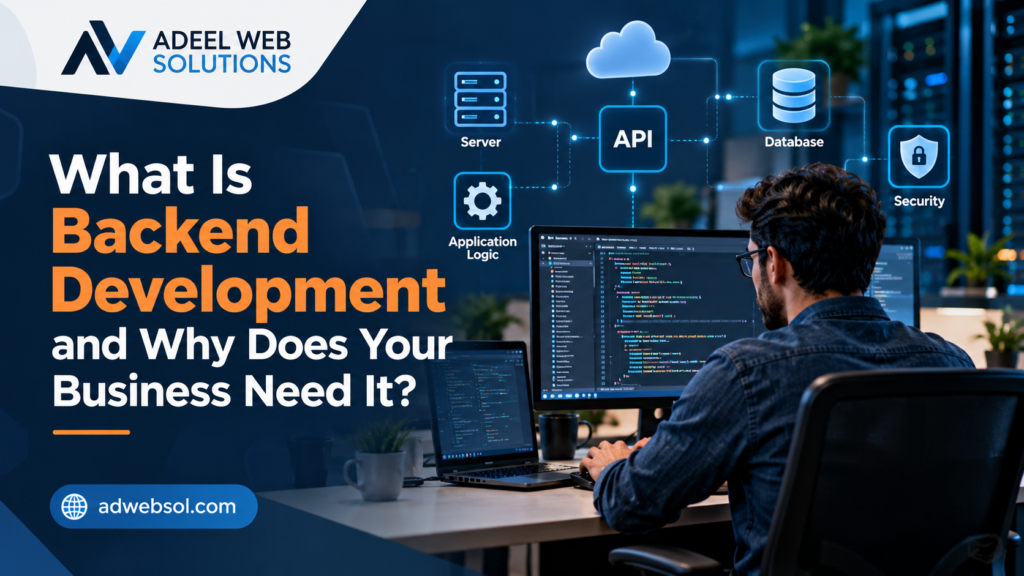
What Is Backend Development and Why Does Your Business Need It?
When customers visit your website, they interact with pages, images, navigation menus, buttons, forms, and other visible elements. But behind these features is another important part of the website that visitors usually never see: the backend.
Backend development handles many of the processes that allow a modern website or web application to function. It can manage databases, process contact forms, authenticate users, handle orders, communicate with payment gateways, connect external software, and perform many other server-side tasks.
For a simple informational website, backend requirements may be relatively limited. For an e-commerce store, customer portal, booking platform, membership website, or custom web application, the backend can become a critical part of business operations.
Understanding backend development can help business owners make better decisions when planning a website or choosing development services.
In this article, we explain what backend development is, how it works, and why your business may need it.
What Is Backend Development?
Backend development is the process of building and maintaining the server-side systems that power websites and web applications.
The frontend is what visitors see and interact with. The backend works behind the scenes to process requests, manage information, apply business rules, and communicate with databases and external services.
For example, when a customer submits a contact form, the backend may:
- Validate the submitted information
- Store the enquiry in a database
- Send an email notification
- Create a lead in a CRM
- Trigger an automated response
- Return a confirmation to the visitor
All of this can happen within seconds without the visitor seeing the underlying technical processes.
Backend development is therefore responsible for much of the functionality that turns a collection of webpages into an interactive business system.
Frontend vs Backend Development
Understanding the difference between frontend and backend development is useful when planning a website.
Frontend Development
Frontend development focuses on the parts of the website users directly see and interact with.
This includes:
- Page layouts
- Navigation
- Buttons
- Images
- Forms
- Typography
- Animations
- Mobile responsiveness
- Interactive interface elements
Common frontend technologies include HTML, CSS, and JavaScript.
Backend Development
Backend development focuses on the systems operating behind the interface.
This may include:
- Databases
- Servers
- User authentication
- Business logic
- Form processing
- APIs
- Payment processing
- Order management
- Administrative systems
Frontend and backend development need to work together.
A professional-looking form is not useful if the backend fails to process the submission correctly. Similarly, a powerful backend provides limited value if the frontend is confusing or difficult for customers to use.
How Does Backend Development Work?
When someone interacts with a website, the frontend may send a request to the backend.
The backend receives the request, determines what needs to happen, communicates with the appropriate systems, and sends a response.
Consider an online store.
A customer clicks Add to Cart and later proceeds to checkout.
Behind the scenes, the website may need to:
Identify Product → Check Information → Calculate Pricing → Apply Discounts → Process Customer Details → Communicate With Payment Service → Create Order → Send Confirmation
The customer sees a straightforward interface, while several backend processes may be working together.
The exact architecture depends on the website, technology stack, traffic levels, security requirements, and business needs.
What Technologies Are Used for Backend Development?
Backend developers can work with many different programming languages, frameworks, databases, and server technologies.
Common backend technologies include languages such as:
- PHP
- Python
- JavaScript with Node.js
- Java
- C#
- Ruby
- Go
Databases may include:
- MySQL
- PostgreSQL
- Microsoft SQL Server
- MongoDB
- SQLite
- Redis for certain caching or data use cases
A business does not usually need to choose a technology simply because it is popular.
The appropriate technology depends on factors such as:
- Existing website platform
- Required functionality
- Expected traffic
- Integrations
- Development budget
- Security requirements
- Scalability
- Maintenance resources
Technology should support the business requirement rather than becoming the objective itself.
1. Your Business Needs Reliable Website Functionality
One of the primary reasons businesses need backend development is functionality.
A static website can display information, but many business websites need to perform actions.
These actions might include:
- Processing enquiries
- Accepting bookings
- Managing customer accounts
- Selling products
- Checking inventory
- Calculating prices
- Processing orders
- Managing memberships
- Sending notifications
- Integrating business software
Backend development makes these processes possible.
The more your business depends on the website for day-to-day operations, the more important backend reliability becomes.
2. Backend Development Powers Contact Forms
Contact forms may appear simple, but several processes can occur after someone clicks the submit button.
The backend may need to:
- Validate fields
- Check required information
- Reduce spam
- Store the submission
- Send an email
- Connect to a CRM
- Record tracking information
- Display a confirmation
For businesses that generate leads through their websites, this functionality is extremely important.
A broken contact form can mean lost opportunities.
Businesses should therefore test important forms regularly rather than assuming they continue to work indefinitely.
3. Backend Development Manages Databases
Many websites depend on databases to store and retrieve information.
A database may contain:
- Website content
- Products
- Orders
- Customer accounts
- Appointments
- Form submissions
- Inventory
- Membership records
- Blog posts
- Business locations
Backend code communicates with the database whenever information needs to be retrieved, added, updated, or removed.
For example, when a customer opens a product page, the website may retrieve product information from the database.
When an administrator changes the product price, the backend updates the corresponding record.
Well-designed database systems help keep information organized and support efficient website operations.
4. Backend Development Supports Website Security
Security is a major responsibility of backend development.
Business websites may handle information submitted by customers, employees, administrators, and other users.
Backend systems should be developed with appropriate security practices.
These may include:
- Input validation
- Authentication
- Password hashing
- Access controls
- Secure database queries
- Session management
- HTTPS
- Appropriate permissions
- Regular software updates
- Protection against common web vulnerabilities
Security requirements vary depending on what the website does and what information it handles.
An informational company website and a platform handling customer accounts and transactions will naturally have different risk profiles.
Security should therefore be considered from the beginning of development.
5. Backend Development Makes User Accounts Possible
If customers or employees need to log into your website, backend functionality becomes essential.
The backend may manage:
- Registration
- Login
- Password changes
- Account information
- Permissions
- User roles
- Session management
Different users may require different levels of access.
For example, an e-commerce customer may be able to view previous orders, while an administrator can manage products, orders, and website settings.
Backend authorization controls what authenticated users are permitted to do.
This helps ensure that sensitive administrative functions are not available to ordinary website visitors.
6. E-Commerce Websites Depend Heavily on Backend Systems
Online stores require considerably more backend functionality than basic informational websites.
An e-commerce backend may manage:
- Products
- Product variations
- Inventory
- Customer accounts
- Shopping carts
- Orders
- Payments
- Discounts
- Shipping
- Taxes
- Refund workflows
- Order notifications
These systems need to work together consistently.
For example, after a successful purchase, the website may need to create an order, update inventory, record payment information, send notifications, and make order details available to the customer.
Reliable backend development is therefore fundamental to a professional e-commerce operation.
7. Backend Development Enables Online Booking
Businesses such as clinics, consultants, service providers, trainers, and other appointment-based companies may use online booking functionality.
Backend systems can help manage:
- Services
- Appointment availability
- Dates and times
- Customer details
- Booking confirmation
- Staff schedules
- Notifications
- Cancellations
- Rescheduling
Without backend logic, the website would have difficulty determining which appointment times are actually available.
Advanced booking systems may also integrate with external calendars, payment platforms, or customer management software.
8. Backend Development Connects Your Website to Other Software
Modern businesses often use multiple digital platforms.
Your website may need to communicate with:
- CRM software
- Email marketing systems
- Accounting platforms
- Payment gateways
- Shipping providers
- Inventory systems
- Appointment software
- Analytics platforms
- Customer support systems
These connections are often created using APIs.
An API allows different applications to exchange information according to defined rules.
For example, when a visitor submits a website enquiry, backend functionality could automatically create a new contact in your CRM.
This can reduce manual data entry and improve business workflows.
9. Backend Development Supports Business Automation
Backend development can automate repetitive tasks.
Depending on the business, automation might include:
- Sending confirmation emails
- Creating leads
- Assigning enquiries
- Updating inventory
- Generating notifications
- Processing scheduled tasks
- Sending appointment reminders
- Updating order statuses
Automation can help businesses manage growing volumes of online activity more efficiently.
However, automated processes should be designed carefully and monitored to ensure they continue working as expected.
10. Backend Development Can Improve Website Performance
Website speed depends on both frontend and backend performance.
Even a lightweight frontend can feel slow if the server takes too long to process requests.
Backend performance can be affected by:
- Inefficient database queries
- Excessive API requests
- Poor caching
- Resource-intensive plugins
- Inefficient application logic
- Large databases
- Inadequate hosting resources
Professional backend development can improve efficiency through techniques such as database optimization, caching, code improvements, appropriate server configuration, and more efficient integrations.
The exact optimization strategy depends on the website architecture.
11. Backend Development Helps Your Website Scale
Your website requirements may change as your business grows.
You may start with a basic service website and later add:
- Customer accounts
- Online payments
- More products
- New locations
- Memberships
- Advanced forms
- CRM integrations
- Automated workflows
- Customer dashboards
A well-structured backend can make these changes easier to implement.
Scalability does not mean every small business needs an expensive enterprise architecture.
It means making sensible development decisions so expected future growth does not require rebuilding everything unnecessarily.
12. Backend Development Supports Content Management Systems
Content management systems such as WordPress rely on backend functionality.
When you log into WordPress and update a page, publish an article, upload an image, or edit a menu, the backend processes and stores those changes.
A CMS allows businesses to manage website content through an administrative interface rather than manually changing code.
Custom backend development can extend this functionality.
For example, a business may need dedicated management areas for:
- Services
- Locations
- Team members
- Testimonials
- Properties
- Events
- Products
- Case studies
This can make website administration easier for employees who are not developers.
Backend Development and WordPress
WordPress combines content management with extensive backend functionality.
WordPress websites commonly use technologies such as PHP and MySQL or compatible databases.
Developers can extend WordPress through:
- Custom themes
- Custom plugins
- Custom post types
- Custom fields
- APIs
- E-commerce functionality
- Advanced forms
- Third-party integrations
Not every requirement needs custom development.
Reliable existing plugins can sometimes provide the required functionality more efficiently.
Custom backend development becomes particularly useful when a business has requirements that cannot be adequately handled by standard solutions.
Backend Development and WooCommerce
WooCommerce adds e-commerce functionality to WordPress and relies extensively on backend processes.
It can manage:
- Products
- Orders
- Customers
- Coupons
- Taxes
- Shipping
- Payments
- Inventory
Businesses can also extend WooCommerce with custom backend functionality.
For example, a company might require:
- Custom pricing rules
- Wholesale functionality
- Specialized shipping calculations
- Product configuration
- Subscription features
- CRM synchronization
- Inventory integrations
The appropriate implementation depends on the business model and operational requirements.
Backend Development Can Support Better SEO
Backend development is not a replacement for SEO, but it can support important technical SEO requirements.
Backend systems can influence:
- URL structures
- Redirects
- HTTP status codes
- XML sitemaps
- Canonical URLs
- Structured data
- Page generation
- Website performance
- Crawlability
Technical mistakes in these areas can create problems for search engines.
Developers and SEO professionals should therefore work together when making significant changes to website architecture.
Custom Backend Development vs Existing Solutions
Not every website feature needs to be custom-built.
Established platforms and plugins can provide reliable solutions for common requirements.
Using an existing solution can often reduce:
- Development time
- Initial cost
- Technical complexity
Custom backend development may make more sense when the business requires:
- Unique functionality
- Specialized integrations
- Custom workflows
- Complex calculations
- Advanced automation
- Proprietary systems
The best solution is generally the one that meets the business requirement reliably without adding unnecessary complexity.
Does Every Business Website Need Advanced Backend Development?
No.
A small website that primarily displays company information may only need basic backend functionality for content management and contact forms.
A more advanced business platform may require considerably more.
For example, a website with customer accounts, online payments, booking, inventory synchronization, or custom dashboards will naturally require more backend development.
The level of backend development should match the actual needs of the business.
Overengineering a simple website can increase costs and maintenance without providing meaningful value.
Signs Your Business May Need Custom Backend Development
Custom backend development may be worth considering if:
- Manual processes are consuming too much time
- Your website needs to connect with business software
- Existing plugins cannot provide required functionality
- Customers need individual accounts
- You require a custom booking process
- Your business needs advanced calculations
- You want to automate repetitive workflows
- Your existing website cannot support future requirements
Before developing a custom solution, businesses should clearly define the problem they are trying to solve.
This helps developers recommend an appropriate technical approach.
Backend Maintenance Is Important
Backend development does not end when the website launches.
Websites need ongoing maintenance.
This may involve:
- Software updates
- Security monitoring
- Database maintenance
- Backups
- Performance monitoring
- Error monitoring
- Integration testing
- Compatibility checks
Third-party services and APIs can also change over time, which may require updates to integrations.
Regular maintenance helps keep the website reliable as its technology and business requirements evolve.
Why Your Business Needs a Reliable Backend
Your website may be one of your most important digital business tools.
If customers use it to request quotes, make purchases, book appointments, access accounts, or communicate with your company, the systems behind those actions need to work reliably.
Professional backend development can help create a website that is:
- Functional
- Secure
- Scalable
- Maintainable
- Efficient
- Integration-ready
- Capable of supporting automation
Customers may never see your backend, but they experience its quality every time they interact with your website.
A reliable backend allows the frontend experience to deliver what it promises.
Build a Stronger Website With Professional Backend Development
Backend development provides the technical foundation behind many modern website features.
Whether you need a straightforward business website, a WordPress solution, an online store, API integrations, automated workflows, or custom web functionality, the backend should be developed according to your actual business requirements.
At Adeel Web Solutions, we provide professional backend development, WordPress development, e-commerce development, custom website development, API integrations, website maintenance, and performance optimization services.
We focus on building reliable solutions that support both your current website requirements and future business growth.
Need backend development for your website or web application?
Contact Adeel Web Solutions to discuss your project and development requirements.
