

United State of America - USA

How Strong Backend Development Improves Website Performance and Security

# How Strong Backend Development Improves Website Performance and Security When visitors use a website, they mainly interact with what appears on their screen—menus, buttons, forms, images, product pages, and other visual elements. Behind those visible features, however, is a backend system responsible for processing data, communicating with databases, managing users, handling requests, and connecting the website with other applications. Strong backend development is essential for creating a website that is fast, reliable, secure, and capable of growing with a business. A professionally developed backend can improve website performance by processing requests efficiently, optimizing database operations, managing server resources, and reducing unnecessary workloads. At the same time, proper backend security practices can help protect customer information, business data, accounts, and critical website functionality. For businesses that depend on their websites for leads, sales, bookings, customer accounts, or daily operations, backend quality can have a direct impact on the overall digital experience. ## What Is Backend Development? Backend development refers to the server-side technology that powers a website or web application. Unlike frontend development, which controls what visitors see and interact with, backend development manages the processes taking place behind the scenes. Backend systems may be responsible for: * Processing form submissions * Managing databases * Creating and authenticating user accounts * Processing online orders * Managing product information * Handling website searches * Connecting third-party applications * Managing bookings and appointments * Sending automated notifications * Processing application data * Controlling user permissions * Delivering dynamic content When a visitor performs an action on a website, the frontend often sends a request to the backend. The backend processes that request, retrieves or updates the necessary information, and returns the appropriate response. The speed, reliability, and security of this process can significantly influence the user's experience. ## Backend Performance Directly Affects Website Speed Website speed is not determined by frontend optimization alone. Even if images, CSS, and JavaScript are properly optimized, a website may still load slowly if its backend takes too long to process requests. For example, when someone opens a product page, the server may need to retrieve product information, pricing, inventory, customer-specific data, and other content from a database. If these processes are inefficient, the visitor may experience delays. Strong backend development focuses on improving how efficiently the server processes these operations. Performance improvements may include: * Optimizing application code * Improving database queries * Implementing caching * Reducing unnecessary processing * Optimizing APIs * Improving server configuration * Managing resources efficiently * Removing outdated functionality A faster backend can contribute to faster page responses and a smoother overall website experience. ## Efficient Database Management Improves Performance Databases are a critical part of many business websites. They can store information such as: * Website content * Customer accounts * Products * Orders * Inventory * Form submissions * Booking information * Customer preferences * Application settings Every time the website needs this information, the backend communicates with the database. Poorly structured databases or inefficient queries can cause significant performance problems, particularly as the amount of stored information grows. Professional backend development can improve database performance through techniques such as: * Efficient database structure * Proper indexing * Optimized queries * Removal of unnecessary data * Reduced duplicate requests * Database caching * Regular maintenance Efficient database management allows the website to retrieve and process information more quickly. ## Caching Can Reduce Server Workload Caching is an important technique for improving website performance. Instead of repeatedly generating the same information for every visitor, caching allows certain content or data to be temporarily stored and reused. Depending on the website architecture, caching may occur at different levels, including: * Browser caching * Page caching * Server caching * Database caching * Object caching * Content delivery networks When implemented correctly, caching can reduce server workload and improve response times. However, caching needs to be configured carefully, particularly for websites containing personalized information, customer accounts, shopping carts, or frequently changing data. Professional backend development ensures that caching improves performance without creating outdated or incorrect website behavior. ## Strong Backend Development Helps Websites Handle More Traffic A website may perform perfectly when only a few visitors are using it. Problems can appear when traffic suddenly increases. For example, marketing campaigns, seasonal promotions, viral content, or business growth can create significantly more website activity. A poorly optimized backend may struggle under increased demand, resulting in: * Slow pages * Database errors * Failed requests * Checkout problems * Server errors * Website downtime Scalable backend architecture is designed to handle increasing workloads more efficiently. Depending on the application, this can involve improved database architecture, caching, optimized code, load management, and appropriate server infrastructure. Planning for scalability can help your website remain reliable as your audience and business grow. ## Backend Security Protects Sensitive Information Many websites collect or process information that should not be publicly accessible. This may include: * Customer contact details * User credentials * Order information * Form submissions * Account information * Business records * Payment-related information Strong backend security helps protect this information from unauthorized access and misuse. Security should be considered during every stage of development rather than added only after a website has launched. Professional backend security practices may include: * Secure authentication * Strong password storage * Input validation * Access controls * Secure database configuration * Session management * API security * HTTPS implementation * Software updates * Security monitoring No website can be guaranteed to be completely immune to security threats, but proper development practices can substantially reduce avoidable vulnerabilities. ## Secure Authentication Protects User Accounts Websites that allow users to create accounts need reliable authentication systems. Authentication determines whether someone is actually authorized to access an account or protected area. Backend developers may be responsible for functionality such as: * User registration * Login systems * Password storage * Password resets * Email verification * Session management * User roles * Account permissions Passwords should never be stored as readable plain text. Secure applications use established password-hashing techniques and appropriate authentication practices to reduce the risks associated with compromised credentials. Additional security measures, such as multi-factor authentication, may also be appropriate for certain applications. ## Input Validation Helps Prevent Malicious Requests Websites frequently receive information from users through forms, search boxes, login pages, checkout fields, APIs, and other inputs. The backend should never automatically assume that submitted information is safe. Input validation checks whether submitted data meets the expected format and requirements before the application processes it. Proper validation can help protect against common security problems and prevent invalid information from entering the system. Backend developers may validate: * Email addresses * Phone numbers * Usernames * Passwords * Form fields * Uploaded files * API requests * Product quantities * Database-related inputs Server-side validation is particularly important because frontend validation alone can potentially be bypassed. ## Access Controls Limit What Users Can Do Not every website user should have access to every function. For example, a normal customer should not be able to access administrative tools, and an employee may only need access to specific areas of an internal application. Backend access controls determine what authenticated users are allowed to view or modify. A well-designed permissions system can include different roles such as: * Administrator * Manager * Editor * Employee * Customer * Subscriber Each role can be assigned only the permissions necessary for its responsibilities. This principle of limiting access can reduce security risks and protect important business functionality. ## API Security Is Increasingly Important Modern websites frequently communicate with external platforms through APIs. An API may connect your website with: * Payment gateways * CRM systems * Email marketing platforms * Shipping providers * Booking systems * Accounting software * Analytics tools * Mobile applications * Inventory platforms These integrations can significantly improve website functionality and business efficiency. However, poorly secured APIs can introduce vulnerabilities. Professional backend development may use authentication, authorization, encrypted communication, request validation, rate limiting, and secure management of API credentials to help protect these connections. ## Backend Development Is Critical for E-commerce Security E-commerce websites require particularly careful backend development because they process orders, customer accounts, addresses, inventory, and payment-related transactions. A secure e-commerce backend can help manage: * Customer authentication * Shopping carts * Product inventory * Order processing * Payment gateway communication * Discounts * Shipping information * Transaction records * Customer notifications Payment information should be handled through appropriate secure payment systems and established providers rather than unnecessarily storing sensitive payment data directly. A reliable backend also helps prevent situations where customers experience incorrect totals, duplicate orders, failed transactions, or inaccurate inventory information. ## Error Handling Improves Reliability and Security Errors are unavoidable in complex applications. The important question is how the system handles them. Poor error handling can expose technical information or cause an entire application to fail because of one unexpected problem. Professional backend development uses controlled error handling to: * Prevent unnecessary application crashes * Record errors for developers * Provide useful responses to users * Protect sensitive technical information * Identify recurring problems * Maintain other functionality when possible For example, if an external API temporarily becomes unavailable, the website should ideally handle the situation gracefully rather than exposing technical server information to the visitor. ## Logging and Monitoring Help Detect Problems A reliable website should provide developers with enough information to investigate technical issues. Backend logging can record important events such as: * Application errors * Failed API requests * Authentication problems * Server issues * Database errors * Unexpected application behavior Monitoring can also help identify performance or availability problems. Depending on the website, monitoring may track: * Server uptime * Response times * Resource usage * Application errors * Database performance * API availability Early detection allows technical teams to investigate problems before they significantly affect customers or business operations. ## Regular Updates Reduce Security Risks Websites often depend on multiple software components. These may include: * Content management systems * Plugins * Libraries * Frameworks * Server software * Database systems * Third-party integrations Security vulnerabilities can be discovered in software over time. Keeping important components updated helps ensure that known security fixes are applied. Updates should still be tested carefully because major software changes can sometimes affect compatibility or functionality. For business-critical websites, a structured maintenance process is generally safer than ignoring updates until something breaks. ## Backups Are an Essential Part of Website Security Security is not only about preventing attacks. Businesses should also prepare for situations where data becomes corrupted, accidentally deleted, or otherwise unavailable. Regular backups provide a recovery option. A backup strategy may include: * Website file backups * Database backups * Automated backup schedules * Off-site storage * Multiple backup versions * Defined retention periods * Recovery procedures Backups should also be tested periodically. A backup that cannot be restored successfully provides limited protection during an actual emergency. ## Backend Optimization Can Improve User Experience Visitors may never see backend code, but they experience its quality every time they interact with your website. A properly optimized backend can result in: * Faster page responses * Reliable forms * Smooth account logins * Accurate search results * Faster product filtering * Reliable checkout * Consistent customer dashboards * Fewer technical errors These improvements make the website feel more professional and dependable. A good user experience therefore depends on both strong frontend design and reliable backend technology. ## Backend Performance Can Support SEO Search engine optimization is often associated with keywords and content, but technical performance also matters. Slow server response times and unreliable website functionality can negatively affect the overall quality of a website experience. Backend optimization can contribute to stronger technical SEO by supporting: * Faster server responses * Stable page delivery * Efficient redirects * Reliable website architecture * Proper handling of errors * Consistent uptime Backend development alone does not guarantee better rankings, but it can provide a stronger technical foundation for SEO efforts. ## Custom Backend Development Supports Business Automation A professionally developed backend can do more than serve website pages. It can automate repetitive business processes. For example, after a customer submits an inquiry, the backend could automatically: * Save the lead * Send a confirmation email * Notify a team member * Add the customer to a CRM * Assign the inquiry to the appropriate department For an online store, automation might: * Update inventory * Process order information * Generate invoices * Trigger shipping workflows * Send customer notifications * Synchronize information with accounting software Automation can save time and reduce repetitive manual data entry. ## Strong Architecture Makes Future Development Easier Businesses change over time. A website that initially requires basic functionality may eventually need: * Customer accounts * Online payments * Advanced forms * New integrations * Additional locations * Mobile application connectivity * Custom dashboards * Subscription functionality * More sophisticated reporting Poorly structured backend code can make these additions difficult and expensive. A well-organized backend makes it easier for developers to understand existing functionality and introduce new features without unnecessarily rebuilding the entire application. ## Performance and Security Should Work Together Performance and security should not be treated as completely separate goals. An extremely fast website that exposes customer information is unacceptable. At the same time, a secure website that is unnecessarily slow and unreliable can create a poor customer experience. Professional backend development aims to balance: * Performance * Security * Reliability * Scalability * Maintainability * Functionality Technical decisions should consider how each of these areas affects the others. The result should be a website that performs efficiently while maintaining appropriate protections for users and business data. ## Signs Your Website May Need Backend Optimization Your website may benefit from backend improvements if: * Pages take too long to respond * The website slows down during traffic increases * Forms occasionally fail * Database-driven pages are slow * Users experience frequent login problems * APIs regularly stop working * Checkout errors occur * Server errors appear frequently * The website uses outdated software * Security updates are being neglected * Adding new functionality has become difficult * Your team relies heavily on repetitive manual processes These symptoms may have different causes, so a technical assessment is usually necessary before deciding on the appropriate solution. ## Build a Faster and More Secure Website With Professional Backend Development Backend development is the foundation that supports many of your website's most important functions. Strong backend architecture can help your website process information efficiently, communicate with databases, protect user accounts, integrate external services, manage transactions, and remain reliable as your business grows. For businesses, investing in professional backend development is not simply a technical decision. It can affect website speed, customer trust, operational efficiency, security, scalability, and the overall user experience. Whether you are developing a new website, improving an existing platform, creating an e-commerce store, integrating business systems, or building a custom web application, a secure and optimized backend provides a stronger foundation for long-term digital growth. ### Frequently Asked Questions **What does backend development do for a website?** Backend development manages server-side processes such as databases, user authentication, form processing, application logic, APIs, orders, and other functionality that operates behind the website's interface. **Can backend development improve website speed?** Yes. Efficient code, optimized database queries, caching, server configuration, and improved application architecture can reduce processing time and improve website response speeds. **How does backend development improve website security?** Backend security can include secure authentication, password hashing, input validation, access controls, secure API communication, database protection, software updates, logging, and monitoring. **What is the difference between frontend and backend security?** Frontend security relates to technology running in the user's browser, while backend security protects server-side applications, databases, authentication systems, APIs, and other infrastructure. A secure website requires appropriate protection across both areas. **Why is database optimization important?** Many websites constantly retrieve and update information in databases. Efficient database structure, queries, and indexing can reduce processing time and help websites perform better as the amount of data increases. **Does a small business website need backend security?** Yes. Even relatively simple websites may contain administrator accounts, contact forms, customer inquiries, plugins, databases, or integrations that need appropriate protection. **How often should a website's backend be maintained?** Maintenance should be ongoing. Updates, backups, security monitoring, performance checks, and functionality testing should be performed regularly based on the website's technology, complexity, and business importance.

How Strong Backend Development Improves Website Performance and Security

When visitors use a website, they mainly interact with what appears on their screen—menus, buttons, forms, images, product pages, and other visual elements. Behind those visible features, however, is a backend system responsible for processing data, communicating with databases, managing users, handling requests, and connecting the website with other applications.

Strong backend development is essential for creating a website that is fast, reliable, secure, and capable of growing with a business.

A professionally developed backend can improve website performance by processing requests efficiently, optimizing database operations, managing server resources, and reducing unnecessary workloads. At the same time, proper backend security practices can help protect customer information, business data, accounts, and critical website functionality.

For businesses that depend on their websites for leads, sales, bookings, customer accounts, or daily operations, backend quality can have a direct impact on the overall digital experience.

What Is Backend Development?

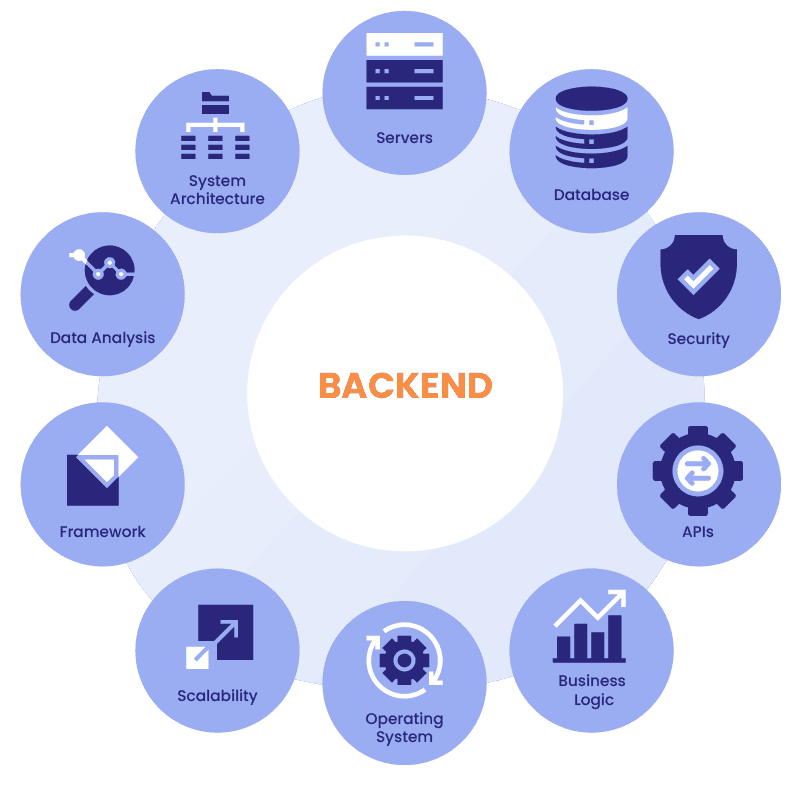
Backend development refers to the server-side technology that powers a website or web application.

Unlike frontend development, which controls what visitors see and interact with, backend development manages the processes taking place behind the scenes.

Backend systems may be responsible for:

  • Processing form submissions
  • Managing databases
  • Creating and authenticating user accounts
  • Processing online orders
  • Managing product information
  • Handling website searches
  • Connecting third-party applications
  • Managing bookings and appointments
  • Sending automated notifications
  • Processing application data
  • Controlling user permissions
  • Delivering dynamic content

When a visitor performs an action on a website, the frontend often sends a request to the backend. The backend processes that request, retrieves or updates the necessary information, and returns the appropriate response.

The speed, reliability, and security of this process can significantly influence the user’s experience.

Backend Performance Directly Affects Website Speed

Website speed is not determined by frontend optimization alone.

Even if images, CSS, and JavaScript are properly optimized, a website may still load slowly if its backend takes too long to process requests.

For example, when someone opens a product page, the server may need to retrieve product information, pricing, inventory, customer-specific data, and other content from a database.

If these processes are inefficient, the visitor may experience delays.

Strong backend development focuses on improving how efficiently the server processes these operations.

Performance improvements may include:

  • Optimizing application code
  • Improving database queries
  • Implementing caching
  • Reducing unnecessary processing
  • Optimizing APIs
  • Improving server configuration
  • Managing resources efficiently
  • Removing outdated functionality

A faster backend can contribute to faster page responses and a smoother overall website experience.

Efficient Database Management Improves Performance

Databases are a critical part of many business websites.

They can store information such as:

  • Website content
  • Customer accounts
  • Products
  • Orders
  • Inventory
  • Form submissions
  • Booking information
  • Customer preferences
  • Application settings

Every time the website needs this information, the backend communicates with the database.

Poorly structured databases or inefficient queries can cause significant performance problems, particularly as the amount of stored information grows.

Professional backend development can improve database performance through techniques such as:

  • Efficient database structure
  • Proper indexing
  • Optimized queries
  • Removal of unnecessary data
  • Reduced duplicate requests
  • Database caching
  • Regular maintenance

Efficient database management allows the website to retrieve and process information more quickly.

Caching Can Reduce Server Workload

Caching is an important technique for improving website performance.

Instead of repeatedly generating the same information for every visitor, caching allows certain content or data to be temporarily stored and reused.

Depending on the website architecture, caching may occur at different levels, including:

  • Browser caching
  • Page caching
  • Server caching
  • Database caching
  • Object caching
  • Content delivery networks

When implemented correctly, caching can reduce server workload and improve response times.

However, caching needs to be configured carefully, particularly for websites containing personalized information, customer accounts, shopping carts, or frequently changing data.

Professional backend development ensures that caching improves performance without creating outdated or incorrect website behavior.

Strong Backend Development Helps Websites Handle More Traffic

A website may perform perfectly when only a few visitors are using it.

Problems can appear when traffic suddenly increases.

For example, marketing campaigns, seasonal promotions, viral content, or business growth can create significantly more website activity.

A poorly optimized backend may struggle under increased demand, resulting in:

  • Slow pages
  • Database errors
  • Failed requests
  • Checkout problems
  • Server errors
  • Website downtime

Scalable backend architecture is designed to handle increasing workloads more efficiently.

Depending on the application, this can involve improved database architecture, caching, optimized code, load management, and appropriate server infrastructure.

Planning for scalability can help your website remain reliable as your audience and business grow.

Backend Security Protects Sensitive Information

Many websites collect or process information that should not be publicly accessible.

This may include:

  • Customer contact details
  • User credentials
  • Order information
  • Form submissions
  • Account information
  • Business records
  • Payment-related information

Strong backend security helps protect this information from unauthorized access and misuse.

Security should be considered during every stage of development rather than added only after a website has launched.

Professional backend security practices may include:

  • Secure authentication
  • Strong password storage
  • Input validation
  • Access controls
  • Secure database configuration
  • Session management
  • API security
  • HTTPS implementation
  • Software updates
  • Security monitoring

No website can be guaranteed to be completely immune to security threats, but proper development practices can substantially reduce avoidable vulnerabilities.

Secure Authentication Protects User Accounts

Websites that allow users to create accounts need reliable authentication systems.

Authentication determines whether someone is actually authorized to access an account or protected area.

Backend developers may be responsible for functionality such as:

  • User registration
  • Login systems
  • Password storage
  • Password resets
  • Email verification
  • Session management
  • User roles
  • Account permissions

Passwords should never be stored as readable plain text.

Secure applications use established password-hashing techniques and appropriate authentication practices to reduce the risks associated with compromised credentials.

Additional security measures, such as multi-factor authentication, may also be appropriate for certain applications.

Input Validation Helps Prevent Malicious Requests

Websites frequently receive information from users through forms, search boxes, login pages, checkout fields, APIs, and other inputs.

The backend should never automatically assume that submitted information is safe.

Input validation checks whether submitted data meets the expected format and requirements before the application processes it.

Proper validation can help protect against common security problems and prevent invalid information from entering the system.

Backend developers may validate:

  • Email addresses
  • Phone numbers
  • Usernames
  • Passwords
  • Form fields
  • Uploaded files
  • API requests
  • Product quantities
  • Database-related inputs

Server-side validation is particularly important because frontend validation alone can potentially be bypassed.

Access Controls Limit What Users Can Do

Not every website user should have access to every function.

For example, a normal customer should not be able to access administrative tools, and an employee may only need access to specific areas of an internal application.

Backend access controls determine what authenticated users are allowed to view or modify.

A well-designed permissions system can include different roles such as:

  • Administrator
  • Manager
  • Editor
  • Employee
  • Customer
  • Subscriber

Each role can be assigned only the permissions necessary for its responsibilities.

This principle of limiting access can reduce security risks and protect important business functionality.

API Security Is Increasingly Important

Modern websites frequently communicate with external platforms through APIs.

An API may connect your website with:

  • Payment gateways
  • CRM systems
  • Email marketing platforms
  • Shipping providers
  • Booking systems
  • Accounting software
  • Analytics tools
  • Mobile applications
  • Inventory platforms

These integrations can significantly improve website functionality and business efficiency.

However, poorly secured APIs can introduce vulnerabilities.

Professional backend development may use authentication, authorization, encrypted communication, request validation, rate limiting, and secure management of API credentials to help protect these connections.

Backend Development Is Critical for E-commerce Security

E-commerce websites require particularly careful backend development because they process orders, customer accounts, addresses, inventory, and payment-related transactions.

A secure e-commerce backend can help manage:

  • Customer authentication
  • Shopping carts
  • Product inventory
  • Order processing
  • Payment gateway communication
  • Discounts
  • Shipping information
  • Transaction records
  • Customer notifications

Payment information should be handled through appropriate secure payment systems and established providers rather than unnecessarily storing sensitive payment data directly.

A reliable backend also helps prevent situations where customers experience incorrect totals, duplicate orders, failed transactions, or inaccurate inventory information.

Error Handling Improves Reliability and Security

Errors are unavoidable in complex applications.

The important question is how the system handles them.

Poor error handling can expose technical information or cause an entire application to fail because of one unexpected problem.

Professional backend development uses controlled error handling to:

  • Prevent unnecessary application crashes
  • Record errors for developers
  • Provide useful responses to users
  • Protect sensitive technical information
  • Identify recurring problems
  • Maintain other functionality when possible

For example, if an external API temporarily becomes unavailable, the website should ideally handle the situation gracefully rather than exposing technical server information to the visitor.

Logging and Monitoring Help Detect Problems

A reliable website should provide developers with enough information to investigate technical issues.

Backend logging can record important events such as:

  • Application errors
  • Failed API requests
  • Authentication problems
  • Server issues
  • Database errors
  • Unexpected application behavior

Monitoring can also help identify performance or availability problems.

Depending on the website, monitoring may track:

  • Server uptime
  • Response times
  • Resource usage
  • Application errors
  • Database performance
  • API availability

Early detection allows technical teams to investigate problems before they significantly affect customers or business operations.

Regular Updates Reduce Security Risks

Websites often depend on multiple software components.

These may include:

  • Content management systems
  • Plugins
  • Libraries
  • Frameworks
  • Server software
  • Database systems
  • Third-party integrations

Security vulnerabilities can be discovered in software over time.

Keeping important components updated helps ensure that known security fixes are applied.

Updates should still be tested carefully because major software changes can sometimes affect compatibility or functionality.

For business-critical websites, a structured maintenance process is generally safer than ignoring updates until something breaks.

Backups Are an Essential Part of Website Security

Security is not only about preventing attacks.

Businesses should also prepare for situations where data becomes corrupted, accidentally deleted, or otherwise unavailable.

Regular backups provide a recovery option.

A backup strategy may include:

  • Website file backups
  • Database backups
  • Automated backup schedules
  • Off-site storage
  • Multiple backup versions
  • Defined retention periods
  • Recovery procedures

Backups should also be tested periodically.

A backup that cannot be restored successfully provides limited protection during an actual emergency.

Backend Optimization Can Improve User Experience

Visitors may never see backend code, but they experience its quality every time they interact with your website.

A properly optimized backend can result in:

  • Faster page responses
  • Reliable forms
  • Smooth account logins
  • Accurate search results
  • Faster product filtering
  • Reliable checkout
  • Consistent customer dashboards
  • Fewer technical errors

These improvements make the website feel more professional and dependable.

A good user experience therefore depends on both strong frontend design and reliable backend technology.

Backend Performance Can Support SEO

Search engine optimization is often associated with keywords and content, but technical performance also matters.

Slow server response times and unreliable website functionality can negatively affect the overall quality of a website experience.

Backend optimization can contribute to stronger technical SEO by supporting:

  • Faster server responses
  • Stable page delivery
  • Efficient redirects
  • Reliable website architecture
  • Proper handling of errors
  • Consistent uptime

Backend development alone does not guarantee better rankings, but it can provide a stronger technical foundation for SEO efforts.

Custom Backend Development Supports Business Automation

A professionally developed backend can do more than serve website pages.

It can automate repetitive business processes.

For example, after a customer submits an inquiry, the backend could automatically:

  • Save the lead
  • Send a confirmation email
  • Notify a team member
  • Add the customer to a CRM
  • Assign the inquiry to the appropriate department

For an online store, automation might:

  • Update inventory
  • Process order information
  • Generate invoices
  • Trigger shipping workflows
  • Send customer notifications
  • Synchronize information with accounting software

Automation can save time and reduce repetitive manual data entry.

Strong Architecture Makes Future Development Easier

Businesses change over time.

A website that initially requires basic functionality may eventually need:

  • Customer accounts
  • Online payments
  • Advanced forms
  • New integrations
  • Additional locations
  • Mobile application connectivity
  • Custom dashboards
  • Subscription functionality
  • More sophisticated reporting

Poorly structured backend code can make these additions difficult and expensive.

A well-organized backend makes it easier for developers to understand existing functionality and introduce new features without unnecessarily rebuilding the entire application.

Performance and Security Should Work Together

Performance and security should not be treated as completely separate goals.

An extremely fast website that exposes customer information is unacceptable. At the same time, a secure website that is unnecessarily slow and unreliable can create a poor customer experience.

Professional backend development aims to balance:

  • Performance
  • Security
  • Reliability
  • Scalability
  • Maintainability
  • Functionality

Technical decisions should consider how each of these areas affects the others.

The result should be a website that performs efficiently while maintaining appropriate protections for users and business data.

Signs Your Website May Need Backend Optimization

Your website may benefit from backend improvements if:

  • Pages take too long to respond
  • The website slows down during traffic increases
  • Forms occasionally fail
  • Database-driven pages are slow
  • Users experience frequent login problems
  • APIs regularly stop working
  • Checkout errors occur
  • Server errors appear frequently
  • The website uses outdated software
  • Security updates are being neglected
  • Adding new functionality has become difficult
  • Your team relies heavily on repetitive manual processes

These symptoms may have different causes, so a technical assessment is usually necessary before deciding on the appropriate solution.

Build a Faster and More Secure Website With Professional Backend Development

Backend development is the foundation that supports many of your website’s most important functions.

Strong backend architecture can help your website process information efficiently, communicate with databases, protect user accounts, integrate external services, manage transactions, and remain reliable as your business grows.

For businesses, investing in professional backend development is not simply a technical decision. It can affect website speed, customer trust, operational efficiency, security, scalability, and the overall user experience.

Whether you are developing a new website, improving an existing platform, creating an e-commerce store, integrating business systems, or building a custom web application, a secure and optimized backend provides a stronger foundation for long-term digital growth.

Frequently Asked Questions

What does backend development do for a website?

Backend development manages server-side processes such as databases, user authentication, form processing, application logic, APIs, orders, and other functionality that operates behind the website’s interface.

Can backend development improve website speed?

Yes. Efficient code, optimized database queries, caching, server configuration, and improved application architecture can reduce processing time and improve website response speeds.

How does backend development improve website security?

Backend security can include secure authentication, password hashing, input validation, access controls, secure API communication, database protection, software updates, logging, and monitoring.

What is the difference between frontend and backend security?

Frontend security relates to technology running in the user’s browser, while backend security protects server-side applications, databases, authentication systems, APIs, and other infrastructure. A secure website requires appropriate protection across both areas.

Why is database optimization important?

Many websites constantly retrieve and update information in databases. Efficient database structure, queries, and indexing can reduce processing time and help websites perform better as the amount of data increases.

Does a small business website need backend security?

Yes. Even relatively simple websites may contain administrator accounts, contact forms, customer inquiries, plugins, databases, or integrations that need appropriate protection.

How often should a website’s backend be maintained?

Maintenance should be ongoing. Updates, backups, security monitoring, performance checks, and functionality testing should be performed regularly based on the website’s technology, complexity, and business importance.

Sidebar CTA

Contact

Name(Required)

Ready to Grow Your Business in United State of America - USA?

Get started with a free consultation today. We’ll discuss your business goals and create a customized digital marketing strategy to help you attract more customers, increase visibility, and achieve sustainable growth in Faisalabad and beyond.

Start Your Growth

Let's Scale Your Business

Ready to dominate your market? Fill out the form below for a free, no-obligation strategy audit and discover how Adeel Web Solutions can help you generate more leads, increase visibility, and accelerate business growth.

Available Nationwide

Contact Us

We’re here to help you grow.

Call Us Directly

+92 (321) 7621717

Email Support

adeel7040@gmail.com

Office Location

United State of America - USA

Free Audit Included

Every inquiry gets a complimentary SEO & Website health check report ($299 value).

Contact

Name(Required)

Book Your Strategy Call

Schedule a time to discuss your business growth.